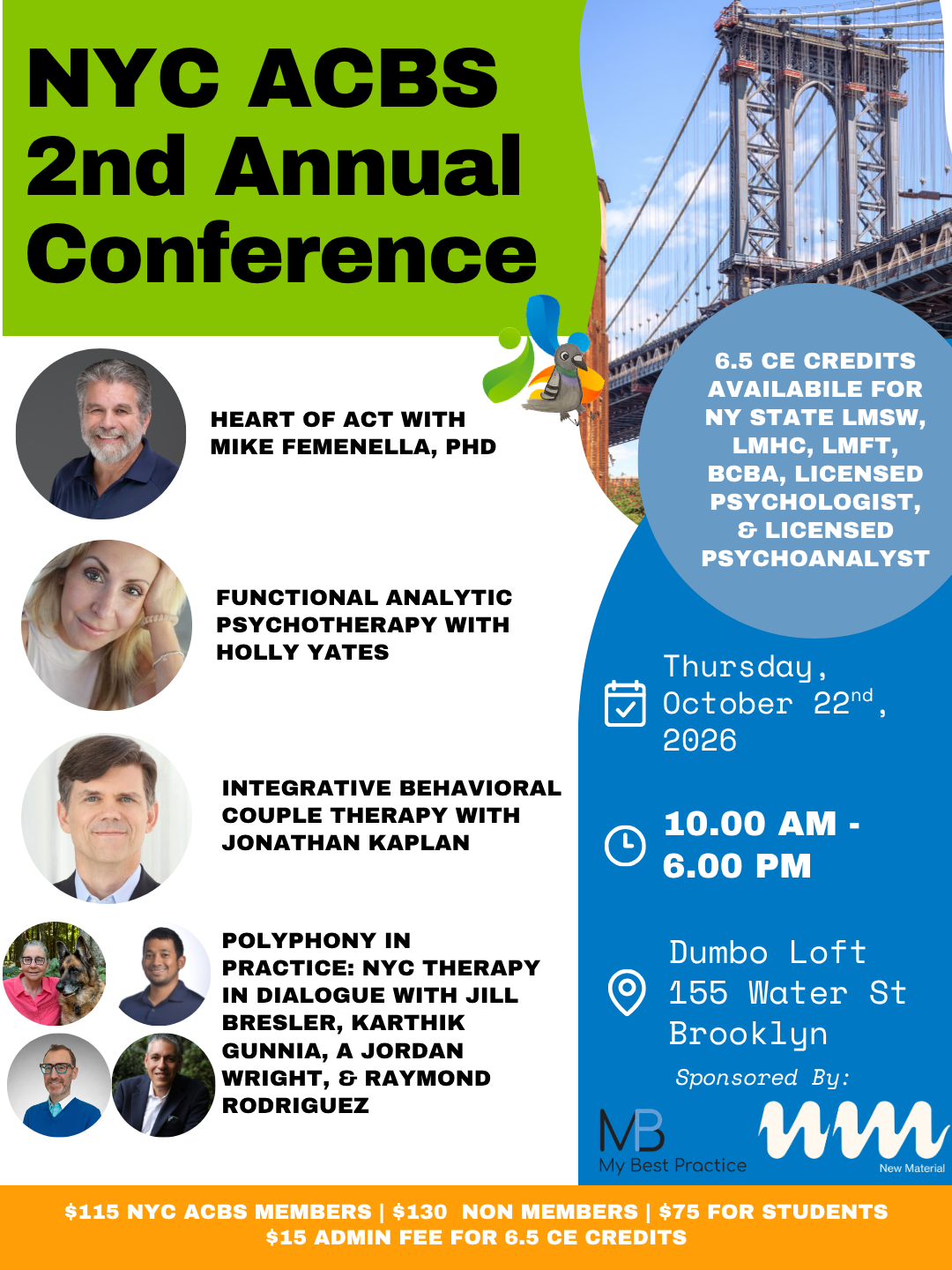
The 2nd Annual NYC ACBS Conference is officially on the calendar! Join us for a full day of learning, connection, and inspiration as we bring together behavioral health professionals from across New York City and beyond.
This year's program features an incredible lineup of presenters and experiential discussions across therapies:
Conference Schedule
10:00 – 10:30 AM
Registration + Welcome
10:30 – 11:55 AM
Heart of ACT with Mike Femenella
In this experiential and interactive Acceptance and Commitment Therapy training, Mike Femenella will bring his 50 years of experience to demonstrating the core processes of ACT. He will guide participants through each part of the model with heart and wisdom.
Learning Objectives:
1. Have a firm grasp of the core processes of acceptance and value commitment
2. Identify experiential avoidance and how it limits valued behavior
3. Cite the benefits of bringing awareness to the here and now
12:00 – 1:30 PM
Functional Analytic Psychotherapy with Holly Yates
Functional Analytic Psychotherapy (FAP) is a therapeutic model that focuses on shaping adaptive interpersonal behaviors in the moment of the therapy interaction. FAP is dedicated to “establishing intense and curative relationships” achieved through authenticity (Kohlenberg & Tsai, 1991). FAP, at its heart, is an interpersonal behavior therapy in which the therapist- client relationship is the agent of change. The therapist responds skillfully to in-the-moment, clinically relevant behaviors (CRB), to evoke and reinforce more adaptive behaviors that help the client build a more effective behavioral repertoire. FAP increases the client’s awareness of moves away from valued living and creates opportunities for immediate practice of courageous behavior - all in the context of a caring relationship. While FAP is an effective therapeutic modality on its own, it can also be integrated with other therapeutic approaches.
Learning Objectives
Describe the theoretical basis for Functional Analytic Psychotherapy
Identify and describe the five rules of FAP which guide therapist interventions
Identify Clinically Relevant behaviors and practice evoking and shaping more effective behavioral repertoires
1:30 – 2:30 PM
Lunch
2:30 – 3:45 PM
Integrative Behavioral Couple Therapy with Jonathan Kaplan
In recent years, couple therapy has seen rise in demand and viewership (e.g., Couples Therapy). While many couple therapies focus on improving communication skills and other aspects of relationships, Integrative Behavioral Couple Therapy (IBCT) was developed to promote the importance of acceptance. Recognizing that not everything--or everyone--can be changed, IBCT focuses on the ways in which empathy and understanding promote connection and intimacy in relationships. Substantiated by empirical research (e.g., Christensen et al., 2006), IBCT constitutes an evidence-based, 3rd-wave approach to couple therapy.
Learning Objectives
Learn the basics of IBCT and how it compares to Acceptance and Commitment Therapy
Understand the evidence-base for IBCT
Identify the four factors involved in an IBCT case conceptualization
3:45 – 4:00 PM
Break
4:00 – 6:00 PM
Polyphony in Practice: NYC Therapy in Dialogue with Jill Bresler, Karthik Gunnia, A Jordan Wright, & Raymond Rodriguez
In this interactive two hour panel, moderated by leading figure in psychotherapy integration Jill Bresler PhD, three highly experienced New York City clinicians and trainers will offer case conceptualization on a single case, from the perspective of psychodynamic (A Jordan Wright, PhD, ABAA, ABPP), Cognitive Behavioral (Karthik Gunnia, PsyD), and Sensorimotor (Raymond Rodriguez, LCSW, Rev) therapy. The case will be presented, and each panelist will offer a modality-specific atlas for understanding key processes in the case, as well as interventions. Dr. Bresler will facilitate a discussion among the three, and then the dialog will extend to a Q&A session with participants.
Learning Objectives
Participants will learn about common factors across ACT, CBT, Psychodynamic, and Sensorimotor modalities
Participants will name and describe interventions specific to these evidence-based models
Participants will identify at least three differences in approach among the evidence-based modalities
Whether you're new to contextual behavioral science or a long-time member of the community, we hope you'll join us for a day of meaningful conversations, practical learning, and opportunities to connect with colleagues who share a commitment to compassionate, evidence-based care.
When: Thursday, October 22nd, 2026 | 10 AM - 6 PM ET
Where: The Dumbo Loft, 155 Water St, Brooklyn, NY 11201
Cost: $115 for members, $130 for non-members, $75 for students. $15 admin fee for 6.5 CE credits